Classificatie van optische vezels — Singlemode, Multimode en prestaties
Inhoud
Niet alle optische vezels zijn gelijk. Het type vezel bepaalt het debiet, de afstand, de compatibiliteit en de kosten van uw installatie. Dit artikel classificeert vezels op transmissiemodus (singlemode vs multimode), beschrijft de standaarden (OS2, OM1 tot OM5) in detail en legt de prestatiekenmerken uit die u moet kennen om de juiste kabel te kiezen.
Classificatie op transmissiemodus
De propagatiemodus in een optische vezel hangt af van de diameter van de kern. Dit is het meest fundamentele classificatiecriterium.
Singlemode-vezel (SMF — Single Mode Fiber)
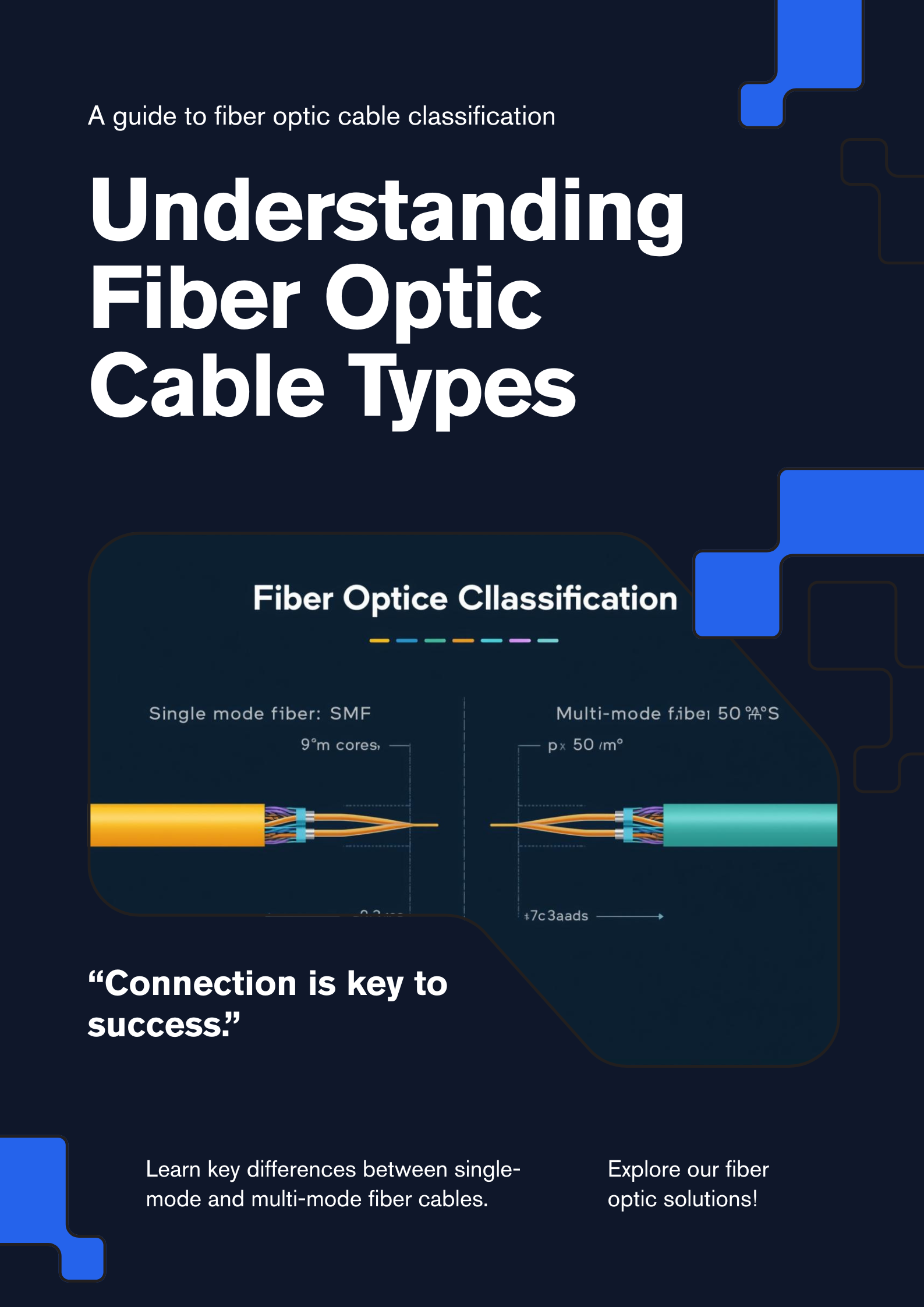
De singlemode-vezel heeft een zeer dunne kern (9 µm) die slechts één lichtmodus doorlaat. Resultaat: geen modale dispersie, waardoor transmissie over zeer lange afstanden (10 tot 80+ km) mogelijk is zonder significant signaalverlies.
- Kerndiameter: 9 µm
- Optische mantel: 125 µm
- Golflengte: 1310 nm en 1550 nm
- Standaard: OS2 (ITU-T G.652D, G.657A2)
- Afstand: 10–80+ km
- Gebruik: FTTH, telecom, campus, tussen gebouwen, backbone
Multimode-vezel (MMF — Multi Mode Fiber)
De multimode-vezel heeft een bredere kern (50 µm of 62,5 µm) die meerdere lichtmodi doorlaat. De modale dispersie beperkt de transmissieafstand, maar de brede kern vergemakkelijkt de koppeling en verlaagt de kosten van de zenders (LED in plaats van laser).
- Kerndiameter: 50 µm (OM3/OM4/OM5) of 62,5 µm (OM1/OM2)
- Optische mantel: 125 µm
- Golflengte: 850 nm (en 1300 nm voor sommige)
- Standaarden: OM1, OM2, OM3, OM4, OM5
- Afstand: 100 m tot 550 m afhankelijk van standaard en debiet
- Gebruik: datacenters, serverruimtes, rack-to-rack-verbindingen
Eenvoudige regel: singlemode voor afstanden > 300 m en telecomverbindingen. Multimode voor datacenters en korte afstanden waar kosten prioriteit hebben.
Singlemode-vezel (SMF) in detail
ITU-T-standaarden
De singlemode-vezel is gestandaardiseerd door de ITU-T (Internationale Telecommunicatie-unie):
- G.652D: standaard singlemode-vezel, de meest verbreide. Gebruikt in alle telecom- en FTTH-installaties.
- G.657A1: vezel met verminderde buigstraal (straal 10 mm). Geschikt voor binneninstallaties.
- G.657A2: vezel met zeer kleine buigstraal (straal 7,5 mm). Ideaal voor huisinstallaties met krappe doorgangen. Dit is de vezel die in Elfcam-kabels wordt gebruikt.
- G.657B3: ultraflexibele vezel (straal 5 mm). Voor microkabels en microbuizen.
Singlemode Elfcam-kabels (G657A2)
- Glasvezelkabels binnen — singlemode patchkabels SC/APC, LC/UPC
- Versterkte buitenkabels — staalgepantserd en LSZH, G657A2-vezel
- Singlemode pigtails — sets van 12/24/48 vezels, alle connectoren
Veelgebruikte singlemode-connectoren
Singlemode-vezels gebruiken voornamelijk de connectoren SC/APC (groen, FTTH-standaard), LC/UPC (blauw, switches en SFP) en LC/APC (groen, lange afstand). Zie onze pagina vezelaccessoires voor koppelingen en adapters.
Multimode-vezel (MMF) in detail
De 5 OM-standaarden
Multimode-vezels worden geclassificeerd van OM1 (de oudste) tot OM5 (de recentste). Het OM-cijfer komt overeen met de modale bandbreedte — hoe hoger het cijfer, hoe beter de prestatie.
| Standaard | Kern | Bandbreedte | Afstand 1G | Afstand 10G | Mantelkleur | Typisch gebruik |
|---|---|---|---|---|---|---|
| OM1 | 62,5 µm | 200 MHz·km | 275 m | 33 m | Oranje | Verouderd, te vervangen |
| OM2 | 50 µm | 500 MHz·km | 550 m | 82 m | Oranje | Bestaande netwerken |
| OM3 | 50 µm | 2000 MHz·km | 550 m | 300 m | Aqua | Datacenter standaard |
| OM4 | 50 µm | 4700 MHz·km | 550 m | 400 m | Aqua / Paars | Datacenter hoge prestaties |
| OM5 | 50 µm | 4700 MHz·km | 550 m | 400 m | Lime green | SWDM, 40/100G multi-λ |
Aanbeveling
Kies voor een nieuwe multimode-installatie minimaal OM3. OM4 verdient de voorkeur als u 10G nastreeft of een evolutie naar 40G/100G voorziet. OM1 en OM2 zijn verouderd.
Singlemode vs multimode: volledige vergelijkingstabel
| Criterium | Singlemode (OS2) | Multimode (OM3/OM4) |
|---|---|---|
| Kern | 9 µm | 50 µm |
| Golflengte | 1310 / 1550 nm | 850 nm |
| Lichtbron | Laser (DFB) | VCSEL (LED) |
| Afstand 1 Gbps | 10–80 km | 550 m |
| Afstand 10 Gbps | 10–40 km | 300–400 m |
| Dispersie | Alleen chromatisch | Modaal + chromatisch |
| Kabelkosten | Vergelijkbaar | Vergelijkbaar |
| Modulekosten | Hoger (laser) | Lager (VCSEL) |
| Mantelkleur | Geel (standaard) | Oranje / Aqua / Lime |
| Hoofdgebruik | Telecom, FTTH, campus | Datacenter, rack-to-rack |
Belangrijkste prestatiekenmerken
Demping (signaalverlies)
De demping meet het verlies van optisch vermogen per kilometer. Hoe lager, hoe verder de vezel kan zenden.
- Singlemode op 1310 nm: 0,35 dB/km
- Singlemode op 1550 nm: 0,22 dB/km (beste prestatie)
- Multimode op 850 nm: 2,5–3,5 dB/km
Dispersie
De dispersie verbreedt de lichtimpulsen tijdens de transmissie, wat het debiet over lange afstand beperkt.
- Modale dispersie: bestaat alleen bij multimode. De verschillende modi arriveren op verschillende momenten.
- Chromatische dispersie: bestaat bij beide types. De verschillende golflengtes propageren met enigszins verschillende snelheden.
Bandbreedte
Gemeten in MHz·km voor multimode. Hoe hoger het cijfer, hoe meer debiet de vezel ondersteunt over een gegeven afstand. OM3 biedt 2000 MHz·km, OM4 bereikt 4700 MHz·km.
Retourverlies
De hoeveelheid licht die naar de bron wordt teruggekaatst ter hoogte van de connectoren. APC-connectoren (hoekpolijsten 8°) bieden een retourverlies ≥ 60 dB (uitstekend), tegenover ≥ 50 dB voor UPC.
Elfcam optische modules per vezeltype
- Singlemode SFP-modules — 1G, 1310/1550 nm, LC duplex, 10–80 km
- SFP+ 10G singlemode-modules — 10G, 1310 nm, LC duplex, 10 km
- SFP+ 10G multimode-modules — 10G, 850 nm, LC duplex, 300 m (OM3/OM4)
Hoe het juiste type vezel kiezen
De keuze komt neer op 3 vragen:
- Welke afstand? — > 300 m → singlemode. < 300 m → multimode mogelijk.
- Welk debiet? — 1 Gbps → singlemode of multimode. 10 Gbps → singlemode of OM3/OM4. 40/100 Gbps → OM4/OM5 of singlemode.
- Welke omgeving? — Telecom/FTTH → singlemode verplicht. Datacenter → multimode vaak voordeliger. Thuis → singlemode (G657A2).
Kies in geval van twijfel singlemode. De meerprijs van lasermodules wordt gecompenseerd door de veelzijdigheid, afstand en schaalbaarheid. Het is een investering die nooit verouderd zal raken.
Installatiegids glasvezel thuis
- Home Fiber — volledige gids om een glasvezelnetwerk thuis te installeren
- Glasvezel-converters — plug & play-verbinding, geïntegreerde SFP
- 10G-switches — multi-gig backbone voor Freebox Ultra